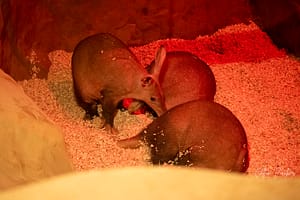
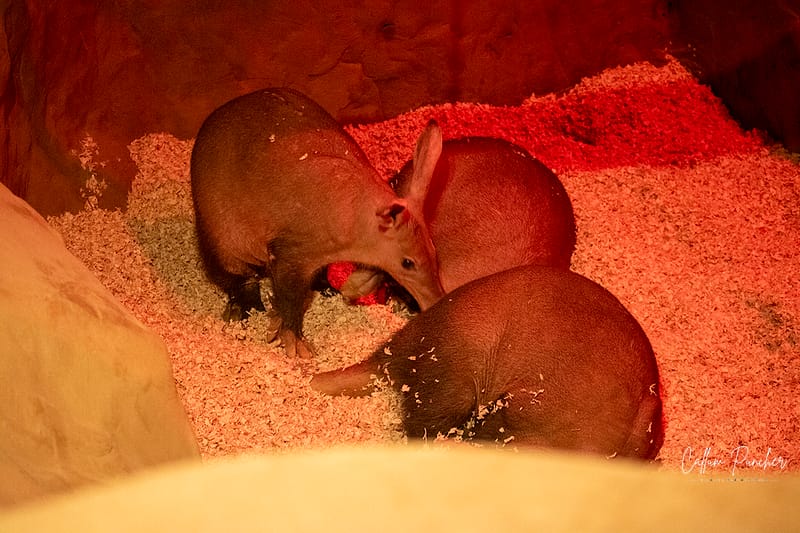
The aardvark, also known as the “earth pig” due to its burrowing habits, is one of the most unusual animals native to Africa. Despite its pig-like snout, the aardvark is more closely related to elephants than pigs, belonging to the ancient order Tubulidentata. It is a solitary, nocturnal mammal that plays a vital role in its ecosystem by digging extensive burrows and controlling insect populations.
Size
Aardvarks can grow up to 2.2 meters (7 feet) in length, including their tail, and weigh anywhere between 60 to 80 kg (132 to 176 pounds). They have a distinctive long snout and large ears. Their bodies are covered in sparse, yellowish-gray hair, which can take on a reddish hue from the soil. Their legs are strong and adapted for digging, and their long tongues help them capture ants and termites.
Location
Aardvarks are widespread across sub-Saharan Africa, inhabiting a variety of habitats such as savannas, grasslands, and woodlands. They avoid overly dry, rocky areas where digging would be difficult. Aardvarks are typically found in regions with loose soil, where they can easily excavate burrows, some of which can extend more than 10 meters (33 feet) in length. They can be found in Botswana, Gambia, Zimbabwe and others.
Population
Aardvarks are currently listed as “Least Concern” by the IUCN. Though their population is stable, habitat destruction and human conflict can pose threats in some regions. Due to their elusive, nocturnal nature, exact population numbers are difficult to determine, but they are not considered endangered at present.
Orycteropodidae Family Group
Aardvarks belong to the family Orycteropodidae, and they are the only remaining species of the order Tubulidentata. This order is characterized by unique, tube-like teeth that grow continuously, a feature that distinguishes aardvarks from most other mammals. While aardvarks share similarities with other insectivores, their closest relatives are elephants, hyraxes, and manatees.
Diet
Aardvarks are myrmecophagous, meaning their diet consists almost entirely of ants and termites. They use their strong, sharp claws to break into termite mounds and ant nests, and their long, sticky tongue to capture thousands of insects in one night. Aardvarks can travel long distances, up to 18 miles, in search of food. In addition to insects, they also consume a unique fruit known as the “aardvark cucumber,” which provides them with additional moisture.
Predators
Adult aardvarks face few natural predators due to their size and ability to quickly dig burrows for shelter. However, lions, leopards, and hyenas may prey on them occasionally. Their burrows provide shelter not only for themselves but also for other animals like wild dogs, making them essential to the ecosystem. Human activities, particularly farming and habitat loss, pose the greatest threats to aardvarks.
Fun Facts
Did you know that aardvarks can dig burrows 2ft deep in only 15 seconds . They are also considered keystone species because their burrows offer shelter for many other animals and control insect populations. Aardvarks rarely need to drink as they gain most of their moisture from insects and aardvark cucumber that they consume.