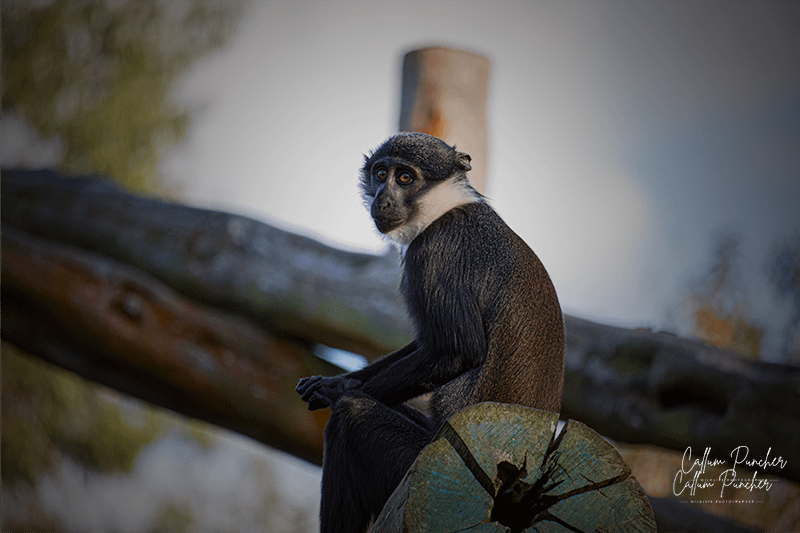

L’hoest monkeys, otherwise known as mountain monkeys, are very agile and good climbers who can survive at great heights in mountains in Central Africa. Lots of its habitat goes through very harsh seasons: very hot, then very cold.
Size
They have very long limbs and tail which helps them with their climbing and balancing skills. Their overall length is 12.5-27in (31.6-68.6cm) with an added length of 19-39in (48.3-99cm) for their tail. With females weighing approximately 3.5kg (7.7Ib) while males are 6kg (13.Ib) which means they are nearly twice as large as females.
Location
These monkeys have quite a limited range because of deforestation but they are still doing well in the protected habitat they live in now. The l’hoest monkeys live around the Democratic Republic of Congo and surrounding countries such as Burundi, Rwanda and western parts of Uganda. Sadly this monkey is in decline.
Population
The l’hoest monkeys have a surprisingly small population with the largest in the Congo basin. The actual figure is estimated at 741-1327 individuals in the wild, with many breeding programs in captivity to help this monkey. They are classified as vulnerable on the IUCN Red List as they are declining although conservation efforts are slowly trying to reverse this.
Cercopithecidae Family Group
Cercopithecidae, otherwise known as old world monkeys, is the largest family group in the order primates. It has 138 species recognised with 34 genera’s. The main difference between new world and old world monkeys are that the new worlds can only be found in Central and South America. Old world monkeys can be found all the way across Africa and Asia including Indonesia.
Diet
L’hoest monkeys are mainly herbivores and frugivores which means they eat fruit and vegetation but will occasionally consume lizards, eggs and some fungi. When food is scarce they will eat smaller birds and mammals. In areas where monkey habitat overlaps with farmland, they are rather guilty of nicking a few crops and fruits.
Predators
These monkeys don’t have many predators, but they are still always on the lookout for sneaky predators prowling the forest floor and skies. Usually, they are preyed on by leopards, and many large species of eagle and birds of prey.In the DRC (Democratic Republic of the Congo) it’s been seen that chimpanzees will hunt l’hoest monkeys with sharpened sticks.
Fun Facts
Did you know that wild l’hoest monkeys have very unusual ways of communicating such as twitching their ears or if males are fighting for dominance they will first stare at each other and raise their eye brows. They will do this for up to 5 minutes without moving or taking their gaze away.

L’hoest’s Monkey Canvas Print
Discover the allure of nature with our exquisite L’Hoest’s Monkey Canvas Print. This captivating artwork features the L’Hoest’s monkey, scientifically known as Cercopithecus lhoesti, celebrated for its distinctive and expressive appearance. Perfect for wildlife art enthusiasts, this print showcases the monkey in its lush forest habitat, emphasizing its pensive expression and detailed fur pattern.