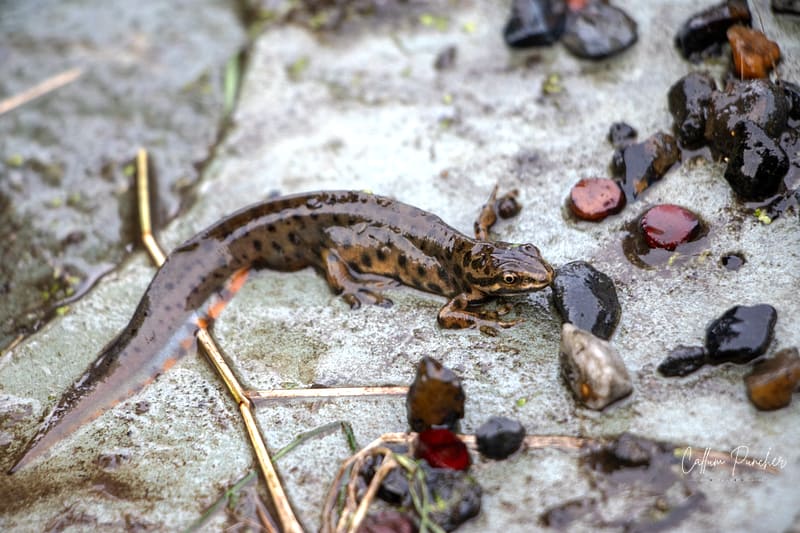
The great crested newt is a reasonably large amphibian that can be found in most shallow ponds and wetlands. They have got striking orange and yellow spots of colours along the side of their body and tail. These newts are often very shy towards most humans and other animals but don’t mind living together in a smaller space.
Size
The great crested newts are quite large compared to many other newts. They can grow up to 17cm in length and weigh around 6.2-10.4g. The males back, neck and tail is covered by a long slender spine that is used to attract a mate. Compared to other newts like the smooth newt, the crested newts have much more warts on the skin.
Location
These newts are widespread across Europe and parts of Asia with many populations in the cooler, more Northern parts of those continents. They can be found in many islands as well as the mainland including Britain (not Ireland), Gotland and Saaremaa (both in the Baltic sea). Their most Northern populations are in the western Fjords in Norway and their Southernmost in the south of France.
Population
The great crested newt has quite a large population of around 400,000 individuals across Europe and Asia but it is in rapid decline. Sadly these newts are suffering from many different threats such as habitat loss and pollution. The small, shallow ponds on farmlands and other suburban areas have been disappearing throughout its whole range meaning hibernation and simply a safe place to live is hard to find.
Salamandridae Family Group
This species of newt is classified in the Salamandridae family group. This group includes both salamanders and newts like the fire salamanders, the eastern newt, the brook salamanders ,and the warty newts. It is comprised of around 144 species and is spread across Europe, Asia, North America and Northern Africa. The most common species in this family is the smooth newt that can be found in similar habitats to the great crested newt.
Diet
For a small amphibian, this newt has a large variety of possible prey for this tiny but mighty carnivore. They prey on many invertebrates such as worms, mayfly, spiders, shrimps and all of their young larvae or nymphs. Molluscs are also part of their diet too. Although great crested newts usually eat insects, they will also kill and eat frogspawn, tadpoles, smaller newts and even their own young!
Predators
As a tiny, soft bodied amphibian, it is obvious that predators love preying on great crested newts. Some of these predators include herons, ducks, large fish, grass snakes, foxes and badgers. Although there are many predators that hunt these newts, they have got good strategies to not get eaten. They will make fierce postures by arching their back, head and tail to warn predators of their poisonous substance that they secrete.
Fun Facts
Did you know that great crested newts can lose their tail and legs like some reptiles can to escape from predators. After they do lose these parts, they can just regrow them along with other parts of their body like their heart, brain, eyes and even their spine!



One Response
I recomend posting about the giant japenese salamander as it is an endagered speices that was used in traditional gormeys plus damming and ruver flooding has caused 80 to 90 percent of them to die out