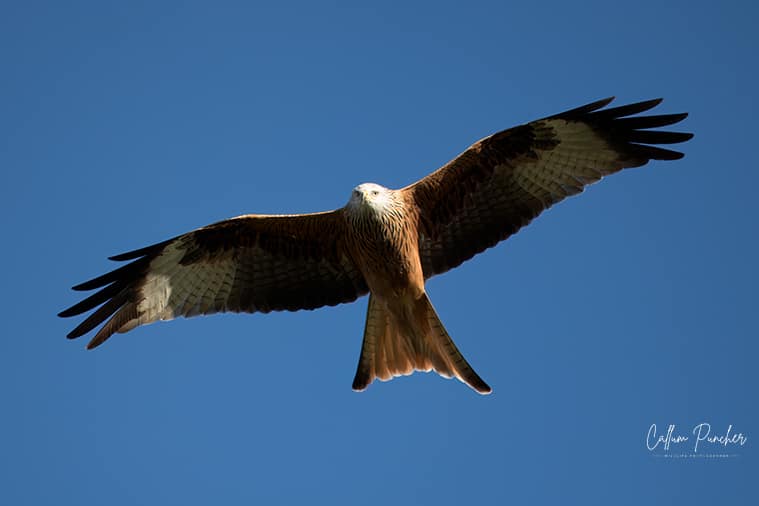

Red kites are spectacular birds that are really easy to identify because of their reddish-brown colour and distinctive call. Many are found near motorway verges as there is an abundance of rodents for them to feast on.
Size
These birds of prey are reasonably large in comparison to buzzards and other predatory birds. For males they can weigh 800g to 1.2kg which is about the same as a bag of sugar, whilst females are slightly heavier at 1.3kg. Their wingspan is 69-71in and their length is around 60 to 70cm.
Location
Although red kites have a large and very established population, they are almost entirely located within Europe because of the ideal weather conditions and habitats for this bird. Their most northerly range is southern Scandinavia because it cannot stand too cold conditions, or too hot. It’s range expanded when reintroduction programmes were successful including in the UK.
Population
The red kites downfall in the 18th and 19th century was so dramatic that there were only a few dozen in the UK left by 1990. These are a few of the countries’ populations in their range, Germany 14,000 to 16,000 pairs, Britain 4,300, Sweden 3,000-4,000, France 3,000 to 3,900, Switzerland 2,800 to 3,400 and Spain 2,300-2,400. Only these 6 countries hold nearly 90% of the population.
Accipitridae Family Group
This is one of the main family groups for birds of prey because it includes 255 species and a whopping 70 genera. This group includes eagles, buzzards, hawks, vultures, other kites, and harriers. This group is found around the globe with some being common and some found only on one island. There are two subspecies of red kites but one is almost certainly extinct.
Diet
Red Kites are mainly scavengers and will normally eat carrion and road kills. If food is very scarce they will take down mice, rats, voles, and even rabbits and pigeons. Even though they are large their talons are not very strong compared to other predatory birds. When there is a large kill like a deer, red kites will gather together and feast together.
Predators
Adults’ size makes them very unlikely to become vulnerable to many predators but their chicks are so small and helpless that if the parents are not experienced enough and leave the chicks unattended they will be snatched by crows and other birds of prey.
Fun Facts
Did you know that the red kites are known to steal hanging laundry and washing to line their nests with. It was even mentioned by Shakespeare himself in one of his books a Winters tale saying ‘when the kite builds, look to lesser linen’.